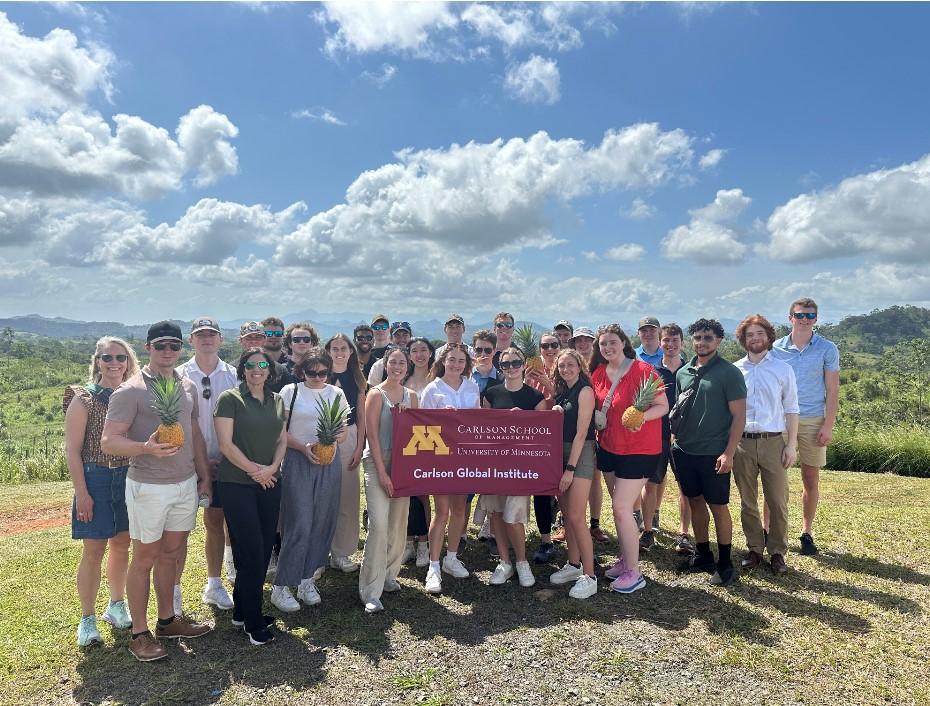
IBUS 3081: Sustainability & Corporate Social Responsibility
Undergraduate Global Enrichment in Costa Rica & PanamaProgram Dates:
This program is full and accepting applications for the waitlist for January 2025. If you submit an application please email the program manager, Mary Krebs.
Class Sessions: Mondays/Wednesdays, 4:00-5:30pm, Fall Semester 2024, B-term only
Overseas Program: Saturday, January 4 - Saturday, January 18, 2025


Program Details
Sustainability, increasingly, no longer hidden within the silo of environmental, health, and safety departments, has become more seamlessly integrated into the operations of corporate functional disciplines. Today, managers need to be knowledgeable not only about their specific business function, but also, about how their decisions will be impacted by governmental regulations & policies, corporate sustainability initiatives, green marketing regulations, industry guidelines or ‘best practices’, new sustainable technologies, energy planning, environmental performance metrics, and required reporting on the environmental impact of their business unit.
This course will focus on environmental responsibility strategies within this relatively new paradigm. It is meant to be introductory, providing an overview of emerging approaches to business and its relationship with the environment. While it will cover overarching management theories, the class will be integrative and practical in its application of corporate sustainability strategies, management, tactics, and tools. We will explore these topics from a global perspective, examining the influence of global trade and unique challenges and opportunities for businesses within Latin America.
At the core of the course is a two-week field experience in Costa Rica. Sustainability can mean many things to many people; a key component of this course will be to explore cross-cultural perspectives of sustainability and the responsibility of business in addressing them.
Costa Rica is a country roughly the size of West Virginia with .03% of the planet’s surface, but 5% of earth’s biodiversity - a density unmatched anywhere in the world. Serving as a land bridge between North and South America, it boasts an enormous range of ecological conditions, from steamy, humid coasts to hot, dry lowlands and cool, mountain cloud forests. It has a progressive social investment policy with one of the most advanced environmental protection systems in the world, protecting 27% of its land in national parks, wildlife refuges and over 100 private reserves and serves as a model for sustainability for the rest of the world. Costa Rica's southern neighbor, Panama, shares similar varying climates and lush tropical rainforests. Yet it's bustling and modern capital, Panama City, is a stark contrast to that of San Jose in Costa Rica. The world famous Panama Canal is a modern marvel that has impacted global supply chains since its launch in 1914 and continues to place the small Central American country of 4 million people on the map for a number of top global industries.
The program hotel(s) will be conveniently located to program activities. Hotel specifics will be provided to participants in the program orientation. Because networking and community-building are essential components of the program, the expectation is that students will share a room with another program participant. If there are other accommodations that would support a student's access and inclusion on the program, there is an opportunity to request such preferences in the Housing Request Form after confirmation in the program. Guests are not permitted during the program. Breakfast will be provided daily at the hotels. A welcome dinner and closing dinner are also included in the program fee.
- 4 credits; 2 Supply Chain (SCO) elective credits are allotted
- Grading is A-F basis
- Priority will go to students who have 100+ credits. If you are a student with alternative considerations, such as DRC accommodations for a reduced course load, please contact the Program Manager to discuss how we can support your application.
- Non Carlson students accepted on a space available basis after the priority deadline
- Students with a GPA below 2.0 will be conditionally accepted pending a conversation with the Program Manager about academic success
U.S. citizens will need a valid passport to travel to Costa Rica and Panama. If you already have a passport, you need to check the expiration date and confirm that it is more than seven months after the program ends. If you do not have a passport, or your passport needs to be renewed, you will need to apply for one immediately upon confirmation.
A visa is a document that proves that travel into a particular country has been approved by their governing body. U.S. citizens do not need a visa for visits up to 90 days for tourism in Costa Rica or Panama. Non-U.S. passport holders should check with the Costa Rican and Panamanian consulates regarding visa requirements and fees. A consulate is a foreign government's official place of residence and representation in a foreign country. While consulates provide passports, birth registration, and many other services, they also have consular sections which issue visas for foreign citizens to visit, study, and work in their country. If you carry a passport other than a U.S. passport and are required to carry a visa into Costa Rica and/or Panama, you will be responsible for securing your visa; you will work closely with the Program Manager (Mary Krebs) to make sure you have any University-specific documentation that you need.
To apply, please visit the Apply page. Students will be charged a $50 application fee. The application cycle starts on March 1, 2024 and the priority deadline is 12:00 pm (noon) on April 1, 2024. Applications for programs that do not fill by the priority deadline will be accepted on a rolling basis until full. Applications to competitive programs will be selected via lottery. Students will be informed of their application decision in about seven to ten days after the priority deadline.
Most financial aid may be applied to study abroad. University of Minnesota students are eligible for education abroad scholarships. Please see Financial Aid and Scholarships for more information.
- Up to 30 University of Minnesota undergraduate students
Classes are on Mondays/Wednesdays from 4:00-5:30pm, B Term, Fall 2024. This course will be taught by Jaime Roquebert, (roque030@umn.edu), from the Strategic Management and Entrepreneurship department. The pre-departure classes are a fundamental component of the curriculum. These pre-departure classes are partly discussion-based given the broad range of diverse and complex challenges faced in international business, and therefore the quality of the student experience is dependent upon all students attending and participating in the pre-departure classes.
In order to be eligible to participate in the international portion of this class, students must maintain satisfactory academic performance as determined by the instructor. If your academic performance prevents you from participating in the international component of the course, you will not receive a refund of the program fee. Please bring any concerns about this directly to the Program Manager (Mary Krebs).
The program starts with a city tour and welcome dinner. The program includes guest lectures, company visits and cultural activities. Included in the program is time for a small amount of independent exploration.
Please contact Program Manager, Mary Krebs, if you have additional questions about the schedule.
Cost Estimate
Fees are based on estimates and may change due to international economic factors. This information applies to 2024-2025 programs.
* Students should also maintain their U.S.-based health insurance plan while abroad.
** Costs are estimated for U.S. passport holders only. Non-U.S. passport holders should check with the Costa Rican consulate regarding the visa application process and costs.
All costs are subject to change prior to departure.
| Fees | Cost |
| 2024-2025 Tuition for 4 academic credits (included in the 13-19 credit tuition plateau) | $0 |
| Program Fee (including international group airfare, hotel accommodation, program events, daily breakfast, two group meals, and international health insurance*) | $5,200 - To be approved |
| International airfare between Minnesota, Costa Rica, & Panama (included in Program Fee, above) | $0 |
| Passport and Photos** | $165 |
| Textbooks | $0 |
| Hotel Accommodation (included in Program Fee, above) | $0 |
| Daily Living Expenses (local transportation, incidentals, data plan, laundry, etc.) | $250 |
| Meals (lunch and dinners not included in Program Fee) | $200 |
| Estimated Total | $5,815 |
| *Does not include $50 regional baggage fee each way | |