Apply for Carlson Case Teams (2023 - 2024)
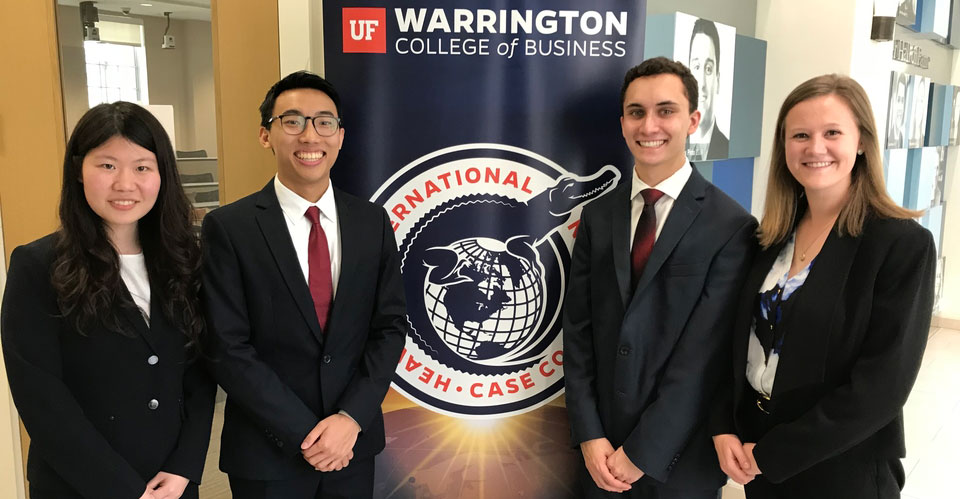
Case Teams Tackle Challenging Business Problems
Does competing against the best universities in the world to solve challenging real-life business problems sound like fun and a great learning experience? If so, consider applying for a Carlson Case Competition team.
We will select up to 8 students (1 - 2 teams) to represent the Carlson School at fast-paced competitions focusing on international business, requiring practical, actionable management solutions.
- MIS-oriented competitions: We have sent teams to MIS competitions for over 12 years. This year we plan to compete at CaseIT (Vancouver, Canada), the oldest and most well known MIS case competition.
- Strategic, cross-functional competitions: We plan to compete against top-tier universities in a strategic, cross-functional competition. In previous years, our teams participated in the APEX Business-IT Global Case Challenge (Singapore Management University), the McDonough Hilltop Business Strategy Challenge (Georgetown University), the Chulalongkorn International Business Case Competition (Thailand), the Central European Case Competition (Corvinus University in Budapest), and the Milgard International Case Competition on Social Responsibility (University of Washington, Tacoma).
These competitions challenge our students to think deeply and present convincingly to groups of executives. The cases require strategic analysis and an action plan ("what can we do on Monday?"). They are proxies for real-life situations in business, consulting, and entrepreneurship.
Our CSOM Case Team alumni have used their case experiences in a wide variety of roles:
- Consulting: Team members have received offers from Deloitte, Boston Consulting, Bain and many other consulting firms.
- Management presentations: Team alumni report success in pitching projects to their management for funding.
- Entrepreneurship: Many team alumni have used these skills in pitching for venture capital funding.
- Future education: Team alumni report that our case experience provided excellent background for our grad school presentations in many top global MBA/MSBA programs.
Interested in learning more?
Check out:
- Intro to the Carlson Case Teams: everything you need to know about joining a Carlson-sponsored case team
- Case 101: how to read and solve competition-style cases
Ready to apply?
Application deadline: Friday, September 29, 2023
Case team tryouts: Thursday, Oct 5, 10am - Tuesday, Oct 10, 10am
- Choose a 48-hour window that is convenient for you, ending no later than 10am on Tuesday, Oct 10.
- We will send you a tryout case at the beginning of your chosen 48-hour window.
- Individually record and submit a 10-minute-or-less video with your solution to our tryout case before your chosen deadline.
Next steps
- Review the application criteria below.
- Review the 2023-24 draft schedule.
- Complete the application by the deadline.
You will try out for the team by creating a short video presentation of your solution to a sample business case. Volunteer industry professionals review your video presentation and recommend you for one of our teams.
More information is available
If you have further questions, we would love to hear from you. You can contact faculty advisor Ken Reily (reil0037@umn.edu).
We envision Carlson teams that bring the strength of diversity in backgrounds, knowledge and interests. Thus, the criteria are broad:
Personal characteristics
- A competitive spirit and strong desire to represent Carlson in global competition.
- Availability and interest to compete in the competition events
- Commitment to team practice throughout both Fall and Spring semester. Previous team members report that, outside of competitions, they average 2 – 3 hours/week.
Course co-requisites or prerequisites
- CSOM students must meet JUST ONE of these requirements (though most of you will meet more than one):
- Any business major: you must be taking (Fall 2023) - or have completed - i-Core
- MIS major or minor: you must be taking (Fall 2023) - or have completed - IDSc 3001
- Business analytics minor: you must be taking (Fall 2023) - or have completed - at least one class in the BA curriculum list
- Special permission: we occasionally give special permission to those who have not taken i-Core (usually transfer students)
- Non-CSOM students must meet this requirement
- CSCI (CLA/CSE), CompENG (CSE), ISysE (CSE) or ITI (CCPS) major: you must have a declared management minor
Class Status
- Your expected graduation date should be May 2024 through May 2026.
Availability (we hope most activities will be face-to-face this year)
- You should be available and a registered UMN student both Fall 2023 and Spring 2024 terms. Please let us know if you plan to study abroad or will otherwise be out of the local area during one of these terms.
- You will register for IDSc 4491 (Independent Study, 1 credit) during Spring Term. The course requires attendance at workshops and practice events. Please review the tentative schedule (linked above) to ensure you are available to work productively with your team!
- Are international students welcome? Yes. Our international students have been key players on our CSOM teams since 2010.
- How hard is it to make the team? We emphasize a well-rounded team with team member strengths in: finance, strategy, MIS, marketing, operations, governance and/or analytics. We value your management skills--from sophomore through senior--and your strong teamwork skills. In general 35-40% of those who try out make a team on their first try.
- What is the most common student concern? Carlson students worry about the time commitment. This is tough to address. We are challenging ourselves against not only our American peer universities (Indiana, Arizona, UT Austin), but top-tier global universities. Teams that practice more feel more prepared for international competition. We look for students who are motivated to balance their time commitment against a desire to test themselves against the best.
- What is the second most common student concern? Carlson students worry that their knowledge and presentation skills are not yet refined. This is an area in which we can help you during our workshops and practice rounds. In fact, we have had i-Core (and IDSc 3001) students on our team every year.
- Is a high GPA required? No. As long as you are not on academic probation, we welcome your application.
- I’ve never done a case before, can I still apply? Yes, definitely. There are a variety of resources available to you:
- See the sections below: How do I learn more? and Practice using the 2016 case.
- Attend / watch the Case 101 workshop (link above)
- Can I request my team/destination? No. In an effort to make sure that teams are balanced and well-positioned to succeed, our corporate judges place students on teams to achieve the best fit.
- This is a real class. How are grades determined? Results matter, thus your team’s placing in your global competition is key. In addition, we take your attendance, preparation, and participation in the workshops and other events very seriously.
- What will this cost me? Our sponsors pay for your registration fees and travel expenses. Students report spending less than $100 out of pocket.
- If I make the team, what dates do I need to block out? This is a moving target since we are now in the midst of accepting competition invitations. You will find a draft schedule for the year linked above.
- Do I try out by myself or with a team? You’ll try out by yourself. We have seminars and practice material available.
- Is this an approved University activity? Technically no, this does not have the same status as a varsity athletic team. You will need to work with your professors to make sure they support your absence for your presentation days. Once you are placed on a team, we’ll work with you to communicate with your professors.
Practice Using the 2016 Tryout Case
Want to practice and see some successful tryout presentations? We have posted the 2015 / 2016 tryout case and a variety of student tryout slides. In order to get the most out of this, we recommend you first orient yourself to the case:
- Purchase and read the Maersk case (it costs $8.95, and we remind you that this is copyrighted material).
- Download and read the supplemental material
- Brainstorm (by yourself) a very high-level solution to the case
- Jot down the type of analysis you are going to use (e.g., how are you going to convince your judges that your solution is a great solution)
Now review six winning presentations from academic year 2015/2016 tryouts and pay attention to:
- The opportunity statement. Only Student A and D nail this part of their presentation
- Timing of the solution. Each student ensures that we hear their solution within the first 2 minutes of their presentation.
- The solution specificity. Each student (except maybe Student F) is crystal clear about their recommendation.
- The difference among solutions. Student A is about employee engagement; Students B and D are about technology; Student C is about expansion into the Baltic; Student F is about advocacy. These are all great solutions.
- The depth and specificity of the analysis (competitor analysis, case study, technical overview, project plan, financial analysis). Here is where you show your skills! Students A & D emphasized financial return, Students B and C build their stories with data.
Please remember that this is an art, not a science:
- You are just seeing slides. Most of these students provided more analysis in their voiceover.
- The quality of these six presentations varies a lot (slide quality, amount of analysis, solution creativity). None of them is meant to be a ‘perfect slide set’.
- We were weak on both technical and financial focus during 2015/2016. We always hope to see more.
Hear from case alumni
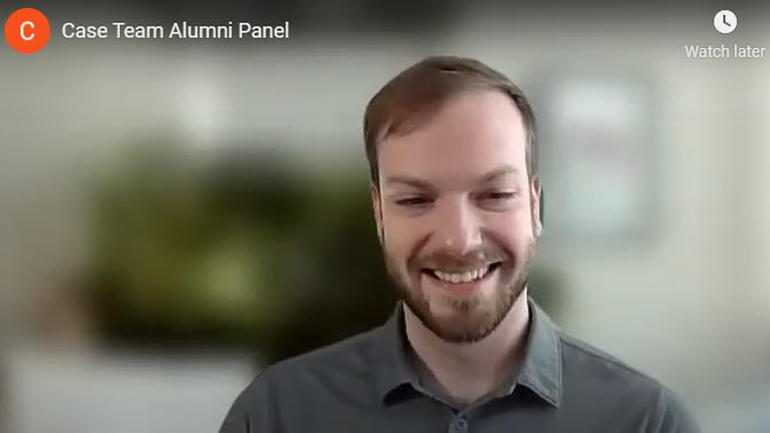
See the videos below to hear case alumni discuss the value the Carlson Case program had on their education and career.